

Age spots (Solar lentigo / Lentigines)
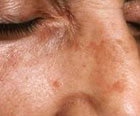 Age
spots occur as result of sun damage very often in childhood. They can
be seen in younger people but are more common in the older age group.
Age
spots occur as result of sun damage very often in childhood. They can
be seen in younger people but are more common in the older age group.
They occur as a result of an increase in the production of melanin in the skin when it is exposed to the sun, and look like brown irregular shaped spots which are larger than freckles.
Age spots and sun damage can be treated effectively with dermabrasion or a chemical peel.
Lines and wrinkles (Rhytides)
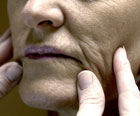 There
are a number of different causes for the formation of lines and wrinkles.
Essentially collagen production is slowed, elastin fibres become less
elastic, dead skin cells do not shed as quickly as in earlier years,
and new skin cell production is slow.
There
are a number of different causes for the formation of lines and wrinkles.
Essentially collagen production is slowed, elastin fibres become less
elastic, dead skin cells do not shed as quickly as in earlier years,
and new skin cell production is slow.
Skin ageing can be due chronological ageing which is natural, slow and progressive and external factors i.e. the sun and environment which contribute to 90% of skin damage.
Lines and wrinkles can often be significantly improved using dermal fillers.

Pigmentation
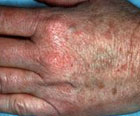 Pigmentation
is a general term to describe a number of facial lesions including age
spots as well as pigmented solar keratoses. These are due to sun damage
and found in people who are over middle age with fair skin. Typically
they will have spent a great deal of time exposed to the sun. The lesions
are found on a bald scalp, face, and hands and are due to an over production
of keratin. The areas are normally large and scaly.
Pigmentation
is a general term to describe a number of facial lesions including age
spots as well as pigmented solar keratoses. These are due to sun damage
and found in people who are over middle age with fair skin. Typically
they will have spent a great deal of time exposed to the sun. The lesions
are found on a bald scalp, face, and hands and are due to an over production
of keratin. The areas are normally large and scaly.
Unsightly pigmentation can often be significantly improved with a chemical peel or needling.
Rosacea
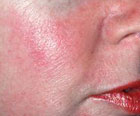 Rosacea
is characterised by flushing and the appearance of red facial thread
veins. The skin may be oily with some pimples.
Rosacea
is characterised by flushing and the appearance of red facial thread
veins. The skin may be oily with some pimples.
The skin condition typically occurs on the forehead, cheeks, skin and lower part of the nose. Although it affects men, it is mostly seen in women between 30 and 50 years and in those who are fair. The cause of rosacea is unknown but it may be triggered by the menopause in women.
Rosacea can often be significantly improved using dermabrasion or a chemical peel.
Thread veins (Spider veins / Telangiectasia)
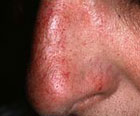 Thread
veins affect at least 55% of the population being more commonly found
in women than men. They can be found on any area of the face.
Thread
veins affect at least 55% of the population being more commonly found
in women than men. They can be found on any area of the face.
To many the veins look broken, but in fact they are dilated. There is no one cause but they can be due to heredity, the extremes of heat and cold, hormones, and ultra-violet light (sun) damage.
Thread veins can be treated either chemically using microsclerotherapy or mechanically using the Veinwave™ system.
Thread veins - Legs
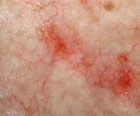 As
well as the causes being similar to facial thread veins, leg thread
veins can also be caused by long periods of sitting or standing, and
anything which increases venous pressure, for instance pregnancy.
As
well as the causes being similar to facial thread veins, leg thread
veins can also be caused by long periods of sitting or standing, and
anything which increases venous pressure, for instance pregnancy.
Thread veins on the legs are usually found in clusters and do not normally pose a health risk. However, as they may give rise to symptoms the underlying cause may need to be investigated further.
Thread veins can be treated permanently either chemically using microsclerotherapy or mechanically using the Veinwave™ system.

Is your complexion dull? Is your skin dry, are wrinkles appearing?
Then try the new light filling PureSense Redensity.
A new concept treatment that redensifies your skin deep down and restores its ability to reflect light.
Read more

We're delighted to announce that Liz has been awarded the Shuco International Award for Special Achievement at the Aesthetic Awards 2015.
The awards took place on December 5th at Park Plaza Westminster Bridge Hotel in London.
Read more about Liz's award here
Our customers say:
“
”